The Course
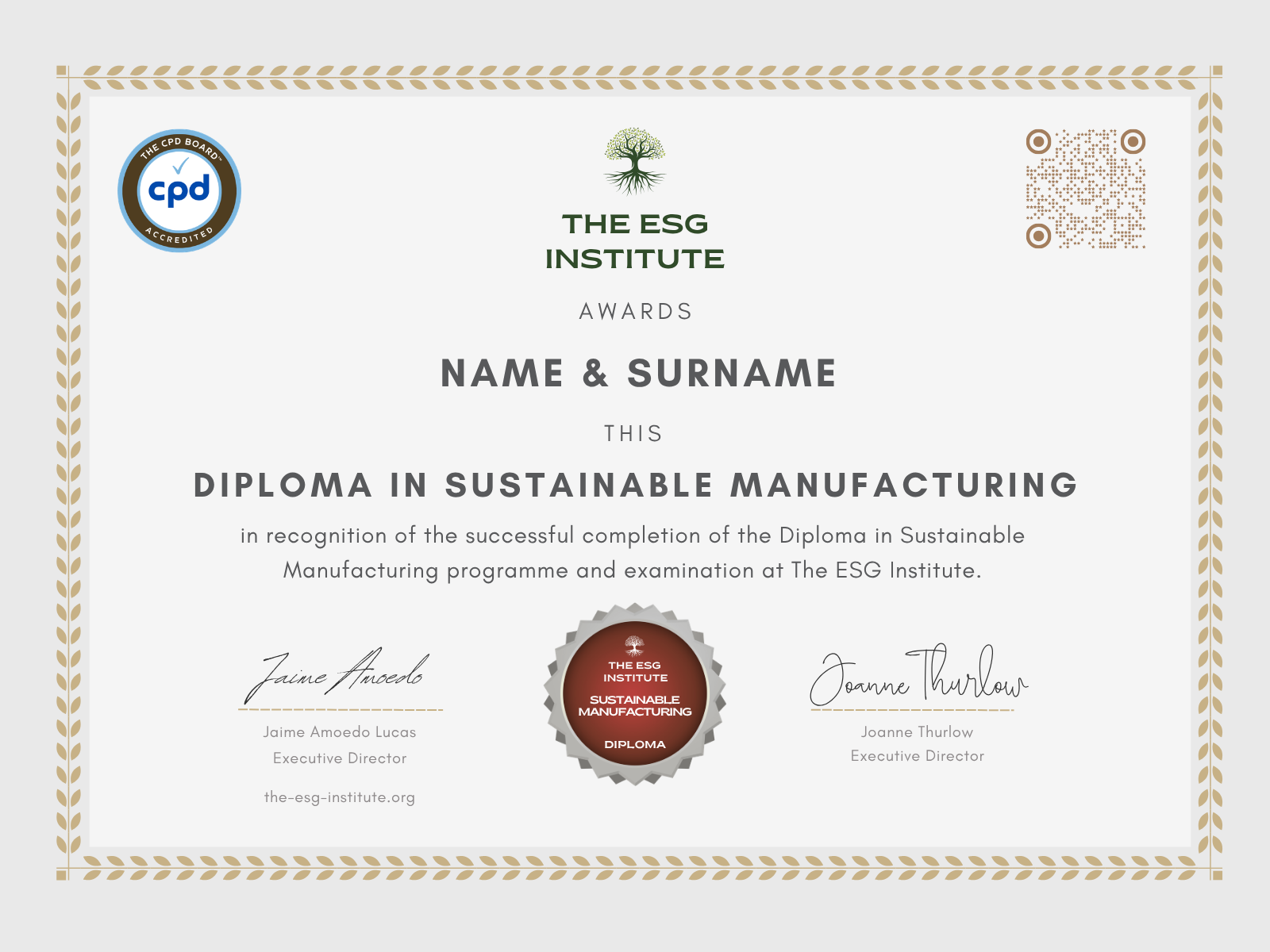
The Diploma in Sustainable Manufacturing develops the skills and judgement needed to assess factory impacts, improve operational performance and plan a funded transition.
It covers resource balances, greenhouse gas accounting, life cycle assessment, product carbon footprints and EPDs, industrial energy and heat, Lean and quality, water, chemicals and pollution, circular product design, supplier decarbonisation and human rights due diligence. Participants learn to evaluate technologies, protect worker health and process safety, apply ISO 14001, ISO 50001 and ISO 45001, navigate the Industrial Emissions Directive and ESPR, and build investment cases and roadmaps.
An interactive simulation and capstone project bring this together through factory improvement and investment decisions and a Sustainable Manufacturing Improvement Plan.
The programme suits operations, engineering, EHS, quality, procurement and sustainability professionals, consultants and manufacturing business owners.
Curriculum
- Choose your language / Elige tu idioma / Choisissez votre langue / اختر لغتك / 选择您的语言 / Выберите язык / अपना भाषा चुनें / আপনার ভাষা নির্বাচন করুন / Escolha o seu idioma / Pilih bahasa Anda / Chọn ngôn ngữ của bạn / Dilinizi seçin / Wählen Sie Ihre Sprache / Scegli la tua lingua / 언어를 선택하세요
- Lesson 0: Welcome and Course Map
- Lesson 1.1: Sustainable Manufacturing: Principles, Impacts and Competitiveness
- Lesson 1.2: Mapping Manufacturing Processes, Factory Systems and Value Chains
- Lesson 1.3: Identifying Material Impacts, Stakeholders and Business Risks
- Lesson 1.4: Customer Expectations, Market Drivers and the Manufacturing Transition
- Lesson 1.5: Developing a Sustainable Manufacturing Strategy and Objectives
- Lesson 2.1: Building a Factory Baseline: Material, Energy and Water Balances
- Lesson 2.2: Calculating Manufacturing Greenhouse Gas Emissions
- Lesson 2.3: Product Footprints: Life Cycle Assessment, Carbon Footprints and EPDs
- Lesson 2.4: Selecting Indicators for Productivity, Resource Efficiency and People
- Lesson 2.5: Managing Data Quality, Uncertainty and Performance Monitoring
- Lesson 3.1: Improving Energy Efficiency in Equipment and Factory Utilities
- Lesson 3.2: Decarbonising Industrial Heat, Cooling and Power
- Lesson 3.3: Reducing Material Losses through Lean, Quality and Maintenance
- Lesson 3.4: Managing Water Use, Wastewater and Local Water Risk
- Lesson 3.5: Preventing Pollution and Managing Chemicals and Hazardous Waste
- Lesson 4.1: Designing Products and Packaging for Durability, Repair and Material Efficiency
- Lesson 4.2: Applying Reuse, Refurbishment, Remanufacturing and Service Models
- Lesson 4.3: Recovering Materials and Developing Industrial Symbiosis
- Lesson 4.4: Decarbonising Purchased Materials and Engaging Suppliers
- Lesson 4.5: Responsible Sourcing, Human Rights Due Diligence and Traceability
- Lesson 5.1: Using Sensors, Automation and AI for Sustainable Operations
- Lesson 5.2: Evaluating Advanced Manufacturing Technologies and Process Changes
- Lesson 5.3: Occupational Health, Process Safety and Labour Rights in the Factory
- Lesson 5.4: Developing Skills, Employee Participation and a Just Transition
- Lesson 5.5: Building Climate Resilience and Manufacturing Continuity
- Lesson 6.1: Integrating Sustainability into Manufacturing Governance and Management Systems
- Lesson 6.2: Navigating Manufacturing Regulation, Product Requirements and Market Access
- Lesson 6.3: Building Investment Cases and Prioritising Improvement Projects
- Lesson 6.4: Delivering a Sustainable Manufacturing Roadmap
- Lesson 6.5: Reporting Performance, Answering Customer Data Requests and Supporting Claims
- Lesson 8.1: Capstone Brief and Route Choice
- Lesson 8.2: Stage 1: Define the Manufacturing Operation, Boundaries and Objectives
- Lesson 8.3: Stage 2: Establish the Baseline and Diagnose Priority Impacts
- Lesson 8.4: Stage 3: Develop and Compare Improvement Options
- Lesson 8.5: Stage 4: Build the Investment Case and Recommend a Portfolio
- Lesson 8.6: Stage 5: Plan Implementation, Governance and Performance Monitoring
- Lesson 8.7: Stage 6: Review, Present and Submit the Improvement Plan
Comprehensive
Covering Factory Performance, Products, Supply Chains and People
Practical
Building Skills Through Worked Cases, Simulation and a Capstone Project
Professional
Developing Evidence-Based Judgement and Credible Improvement Planning