The Course
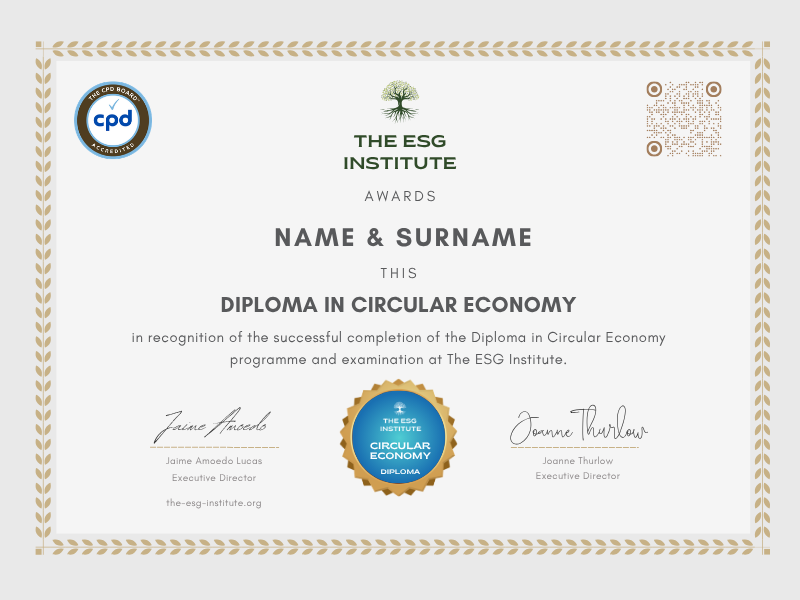
The Diploma in Circular Economy builds the technical knowledge and judgement to keep materials in use at their highest value and to show the evidence behind circular decisions.
The programme starts with circular principles, policy and standards, before covering material flows and metrics.
Participants explore circular design, repair and remanufacturing, packaging reuse and product passports.
It develops skills in circular business models, reverse logistics and finance, alongside sector practice and credible green claims.
The programme concludes with an interactive simulation and a capstone dossier, combining a product range redesign with a separate, board-ready circular transition plan.
It suits: sustainability professionals, product designers, engineers, operations and procurement managers, consultants, and those working in finance, strategy, policy and waste.
Curriculum
- Choose your language / Elige tu idioma / Choisissez votre langue / اختر لغتك / 选择您的语言 / Выберите язык / अपना भाषा चुनें / আপনার ভাষা নির্বাচন করুন / Escolha o seu idioma / Pilih bahasa Anda / Chọn ngôn ngữ của bạn / Dilinizi seçin / Wählen Sie Ihre Sprache / Scegli la tua lingua / 언어를 선택하세요
- Welcome to the course
- Lesson 1. From Linear to Circular: Material Flows, Resource Limits and the Case for Change
- Lesson 2. Schools of Thought: Cradle to Cradle, Industrial Ecology, the Performance Economy and the Ellen MacArthur Foundation Model
- Lesson 3. Technical and Biological Cycles, the Butterfly Diagram and the R-Ladder of Value Retention
- Lesson 4. Circularity, Climate, Nature and People: Emissions, Biodiversity, Just Transition and the Informal Waste Sector
- Lesson 5. The Economic Case: Circularity Gap Data, Resource Productivity and National Circular Economy Strategies
- Lesson 1. The EU Circular Economy Action Plan, the Ecodesign for Sustainable Products Regulation and the Digital Product Passport
- Lesson 2. Waste Law, Extended Producer Responsibility and Packaging Regulation
- Lesson 3. Circular Policy Beyond Europe: China, Japan, Emerging Economies and the Global Plastics Treaty Negotiations
- Lesson 4. The ISO 59000 Series and Other Circular Economy Standards
- Lesson 5. Reporting Circularity: ESRS E5, GRI 306 and the EU Taxonomy Circular Economy Objective
- Lesson 1. Material Flow Analysis and Mass Balance
- Lesson 2. LCA for Circular Decisions: Boundaries, Allocation and Avoided Burden
- Lesson 3. Circularity Metrics: MCI, CTI and ISO 59020
- Lesson 4. Recycling and Recovery Technologies: Mechanical, Chemical and Organic Routes, Quality and Downcycling
- Lesson 5. Economic Assessment: LCC, TCO and Value Retention Modelling
- Lesson 1. Design for Circularity: Durability, Modularity, Repairability and Disassembly
- Lesson 2. Materials Selection: Recycled Content, Bio-Based Materials and Substances of Concern
- Lesson 3. Reuse, Repair, Refurbishment and Remanufacturing Operations
- Lesson 4. Packaging Redesign and Reuse Systems
- Lesson 5. Digital Enablers: Traceability, Product Passports, Sensors and AI-Assisted Sorting
- Lesson 1. Circular Business Model Archetypes: Product as a Service, Sharing, Take-Back and Resale
- Lesson 2. Building a Corporate Circular Strategy: Baseline, Materiality, Targets and Roadmap
- Lesson 3. Reverse Logistics, Circular Procurement and Supply Chain Collaboration
- Lesson 4. Circular Entrepreneurship: Ideation, Validation, Unit Economics and Scaling
- Lesson 5. Financing the Circular Economy: Investment Cases, Risk, Green Finance Instruments and Blended Finance
Comprehensive
Covering Circular Design, Measurement and Finance
Practical
Building Skills Through Worked Cases, Simulation and a Capstone Project
Professional
Developing Evidence-Based Judgement and Credible Circular Claims